Skip to content

Family history for Russian-speaking families

Find your ancestors' records, and the stories only your family remembers.

Get a free research plan that names the right state archive for each ancestor. Send relatives one link: they answer from a phone, no sign-up. Then turn it all into a Family Book.

The product is currently available in Russian for families in Russia, Belarus and Kazakhstan.

85
Russian regions in the research directory, 45 with a verified state archive
Free
research plan for every ancestor. No card needed.
1
payment covers the whole family. No auto-renewal, 14-day refund.

The problem

Grandfather fought. Nobody wrote down where.

Composite story based on conversations with users. Not a testimonial.

Marina is 52 and lives in Samara. She knows her grandparents' names, but her great-grandparents only on her father's side.

Her photos sit on three phones and in one box, half of them with nobody named. Her mother, 78, remembers the villages and surnames. "We will write it down some day."

Her grandfather went missing in 1942. Three times Marina opened the Memory of the People database, and three times she closed it. She did not know what to type or what to do next.

Her tree on MyHeritage disappeared with her account when the service left Russia.

Heritage AI starts where Marina got stuck: it tells her what to type, where to look, and whom to ask.

Why now

A gap opened. Demand is rising.

MyHeritage left Russia

It announced it would delete the accounts of Russian users by 1 February 2025. A tree exported as a GEDCOM file imports to Heritage AI for free.

Sources: Inc. Russia

Millions remember on 9 May

Honouring a war-time relative is a mass practice: the Immortal Regiment march drew over 5 million people in person on 9 May 2026, and up to 7 million in 2025.

Sources: Rossiyskaya Gazeta, 9 May 2026

AI without a foreign API

The assistant runs on YandexGPT in Yandex Cloud, through Yandex AI Studio. It needs no foreign AI service.

Product

From a surname to a family book.

The research plan, the directory and the book work without AI. The AI assistant suggests; a person decides.

01

Know exactly where to look

A route into a real state archive, not into someone else's database. Free for every ancestor, no AI.

  • Enter a surname, a year or decade, a place and the relationship. Get the document types of that era, the archive of that region, links, and questions for relatives.
  • Covers parish registers, confession lists, revision lists, household books, the 1897 census, civil registry (ZAGS) records, wartime databases and evacuation.
  • The directory: 85 Russian regions, 45 with a verified state archive, plus 22 all-Russia sources. Belarus has 3 sources, Kazakhstan 1.
  • Already have a tree? The plan reads its places and years and names the archives and war databases to try.

Letters to archives are templates. You send them. The service does not write to archives for you and cannot promise an answer.

Illustration of the research plan. A fictional family.

02

Everything about a person, on one page

Dates, places, stories, photos and documents, together.

  • Unlimited people on every plan. Import and export GEDCOM, so a tree moves in and out freely.
  • Each person's card has an Era strip: the historical dates that fell inside that life.
  • Photo captions say who, where and when, so no face stays nameless. EXIF and GPS data are removed on upload.
  • A map of roots, a family calendar, a chronicle, and a home screen that shows what changed since your last visit.
Illustration of a person's card. A fictional family.

03

Ask relatives. They answer from a phone.

Relatives remember more than you think.

  • One question, one link. A relative answers without signing up. You decide what is saved.
  • A Question of the Week, from a catalogue of 18, arrives as a card in the app and a Monday email. Email only with consent, and unsubscribe in every message.
  • Relatives who only view the archive are always free.
  • Next, planned for November 2026: a 30-second voice answer with no sign-up. A separate consent comes before recording, and the answer can be deleted.
Illustration of a question and an answer. A fictional family.

04

Turn the archive into a book

From the archive, a book. From a conversation, a story. A person decides.
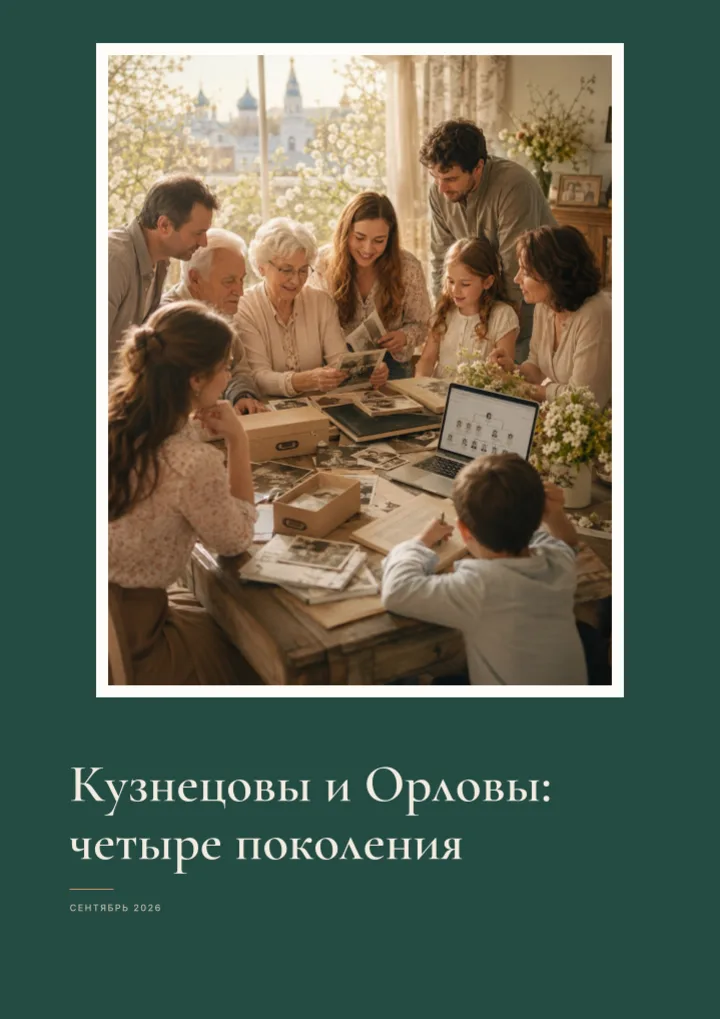
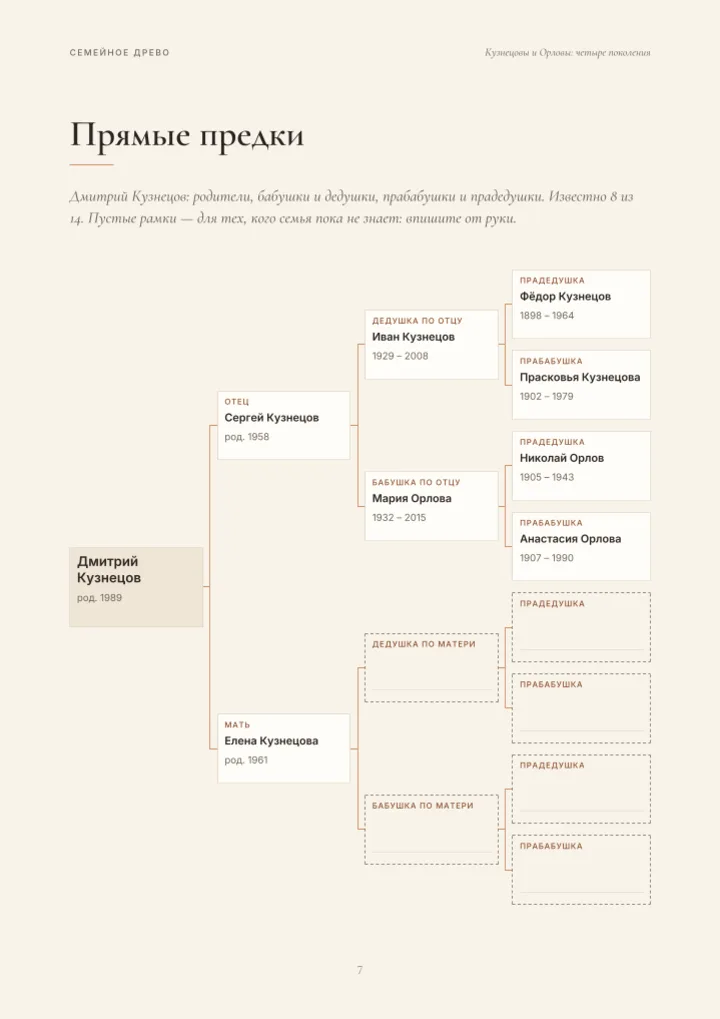
  • The Family Book gathers people, dates, photos and stories into one PDF to read on a screen or print. A public sample is open without an account.
  • The AI assistant runs on YandexGPT. It drafts a story from an interview, summarises the chronicle, suggests questions for an archive letter and helps in the family chat.
  • Three rules: it works only with material you send in that action; it offers a draft and you save it; family data is not used to train AI models.
  • AI spend per family is capped by a family wallet, and every call is logged without the text of the request.
Family Book sample: the coverFamily Book sample: the Direct ancestors page
Pages of the Family Book sample (in Russian).

Return the Name

Search for a World War II soldier. Free forever.

A public project. Planned launch: 3 December 2026, Unknown Soldier Day. Peak: 9 May 2027.

About 2 million Soviet soldiers are still listed as missing in action. The OBD Memorial database holds about 20 million named records of losses.

Sources: Parlamentskaya Gazeta, Vechernyaya Moskva

See the page (Russian)

How it works

  1. Enter a name, a birth year and the place of conscription.
  2. Get a route through OBD Memorial, Memory of the People and Feat of the People, plus a ready request to the Central Archive of the Ministry of Defence (TsAMO) or a military commissariat.
  3. Ask relatives what they remember. They answer from a phone, by link.

Rules, set in advance

  • Free forever: no price, no timers, no promise to "find" anyone.
  • 1941 to 1945 only.
  • Names are never shown publicly.
  • No automatic requests to other databases. We only give you the links.

Market

92% are curious. 35% have a tree.

92%
of Russian adults are interested in their family history
48%
actively learn about their ancestors
35%
of families have a family tree

Source: VCIOM, 2023, n=1,600

Russia has 146.1 million residents (Rosstat, 1 January 2025). Our core audience is families aged 35 to 65.

Sources: Rosstat via Wikipedia

For scale: the global market for genealogy products and services is estimated at $5.2 to $7.3 billion in 2025, growing 11 to 12% a year. The two estimates use different methods.

Sources: TBRC: $5.15B, Kings Research: $7.34B

We found no public report on the size of the Russian market in roubles, so we show demand data instead.

How we make money

Free to start. Families pay for results.

  1. 1. Free

    No time limit

    Unlimited tree, a research plan for every ancestor, one ready archive letter, Ask relatives, and free viewing for everyone you invite.

  2. 2. One-off results

    Pay for what you get

    The Family Book is a one-time purchase at 1,490 RUB. More one-off results are planned.

  3. 3. Family plan

    One payment, whole family

    Family Archive costs 2,990 RUB a year and covers the family's shared archive. Relatives do not pay.

A payment buys a year of access. It never renews by itself, we do not store your card, and the first payment is refundable for 14 days.

See pricing

Technology and AI-native team

One founder, AI agent teams, days not quarters.

Stack

  • Five Java services (Spring Boot 3.5), React 18 with TypeScript, PostgreSQL 16 with a separate database per service.
  • Yandex Cloud, Yandex Object Storage, YandexGPT through Yandex AI Studio.
  • Passwords hashed with bcrypt, two-factor secrets encrypted with AES-256-GCM, TLS with HSTS and CSP.
  • An AI audit log without the text of requests. EXIF and GPS data removed from photos.
  • CI runs backend and frontend tests, Playwright end-to-end tests, CodeQL and Trivy, and starts every service's application context before a release.

How we build

  • The founder briefs teams of AI agents with defined roles: product analyst, designer, frontend and backend engineers, QA, privacy review under the Russian personal data law (152-FZ), security audit.
  • Each team returns a report with evidence. The founder makes every decision and alone holds money, keys, releases and legal signatures.
  • The result: features ship in days, not quarters.

Roadmap

What ships in the next 12 months.

A plan, not a promise. Dates follow the founder's calendar.

  1. Q4 2026

    • Voice answers in Ask relatives
    • Return the Name launches on 3 December
    • A family-book gift for the New Year
  2. Q1 2027

    • Voice answers in the Family Book through a QR code
    • A "My family history" kit for teachers
    • Install to the phone's home screen (PWA)
  3. Q2 2027

    • Return the Name peaks on 9 May: 85 regional guides, a printable "Memory Leaf" for the Immortal Regiment
    • A spoken story of an ancestor
    • Deeper coverage of Belarus and Kazakhstan
  4. Q3 2027

    • Matches between family trees, only with the consent of both sides
    • Genealogist partners under contract
    • Archive collections only with licences

Team

A small team, open to advisors.

Founder

Zakhar Dvurechensky

Builds the product, ships every release, answers support and runs marketing.

Roles defined in the repository

AI agent teams

Product analyst, product manager, UX and UI designer, frontend and backend engineers, QA with evidence, privacy review, security audit, copywriter.

Who we are looking for

  • A genealogist or archivist, to keep the directory and the plans accurate.
  • A lawyer for the Russian personal data law (152-FZ) and advertising rules.
  • Later: a second engineer, and a marketer for Return the Name.

Introductions we value as much as money: regional archives and Rosarkhiv, the Immortal Regiment and the search-party movement, and media that cover family history.

Contact

Talk to the founder.

A question, a partnership, an introduction. The founder reads every message.

support@heritageai.ruProject channel on Telegram (in Russian): t.me/heritageai

The product is currently available in Russian for families in Russia, Belarus and Kazakhstan.